The Characteristics of a Tropical Wave
| Low pressure disturbances, which travel along the intertropical convergence zone, are called __________. |
| A. permanent waves |
| B. tropical storms |
| C. tropical waves |
| D. tidal waves |
| Answer: C |
| What kind of pressure systems travel in tropical waves? |
| A. Subsurface pressure |
| B. Terrastatic pressure |
| C. High pressure |
| D. Low pressure |
| Answer: D |
| In the Northern Hemisphere, what type of cloud formations would you expect to see to the West of an approaching tropical wave? |
| A. Cumulus clouds lined up in rows from Northeast to Southwest |
| B. High altostratus clouds in the morning hours |
| C. Cirrostratus clouds lined up in rows extending in a Northeast to Southwest direction |
| D. Cirrostratus clouds lined up in a North to South direction |
| Answer: A (Tropical waves are lows so clouds would have vertical development.) |
The Behavior of a Tropical Wave
| A tropical wave is located 200 miles due West of your position, which is North of the Equator. Where will the wave be in 24 hours? |
| A. Farther away to the West |
| B. Farther away to the East |
| C. In the same place |
| D. Closer and to the West |
| Answer: A (Easterly waves move west, bringing with them cloud formations consistent with low pressure systems.) |
| You are in the Northern Hemisphere and a tropical wave is located 200 miles due East of your position. Where will the wave be located 12 hours later? |
| A. Farther away to the East |
| B. Nearby to the East |
| C. In the same position |
| D. Farther away to the West |
| Answer: B (Easterly waves move West.) |
The following mesmerizing video illustrates, through a series of high-resolution global simulations, African easterly waves and the formation of Hurricane Helene in 2006.
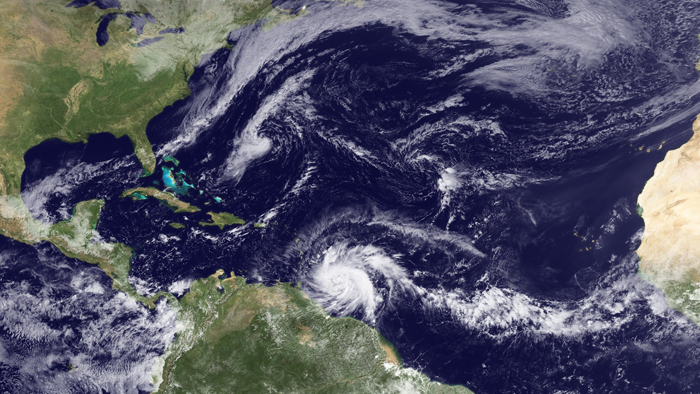
 encouraging, it evolves into a tropical depression and the isobars close. If disturbed (and depressed) it morphs into a tropical storm. And if not stopped, what emerges is a Betty or Bruce, Camille, Florence, Gustav, Harvey, Hugo, Katrina or Maria.This week we will look at the first stage.